What is payment orchestration — and when do you need it?
Payment orchestration explained: how one integration routes payments across multiple PSPs and acquirers, when it pays off, and what to look for.
 AQ Pay Payments Team··4 min read
Most businesses start with one payment provider. It's the right call: one contract, one integration, one dashboard. The trouble starts later — when you expand into a new country, a provider has an outage on your busiest day, or finance asks why approval rates differ by card type and nobody can answer.
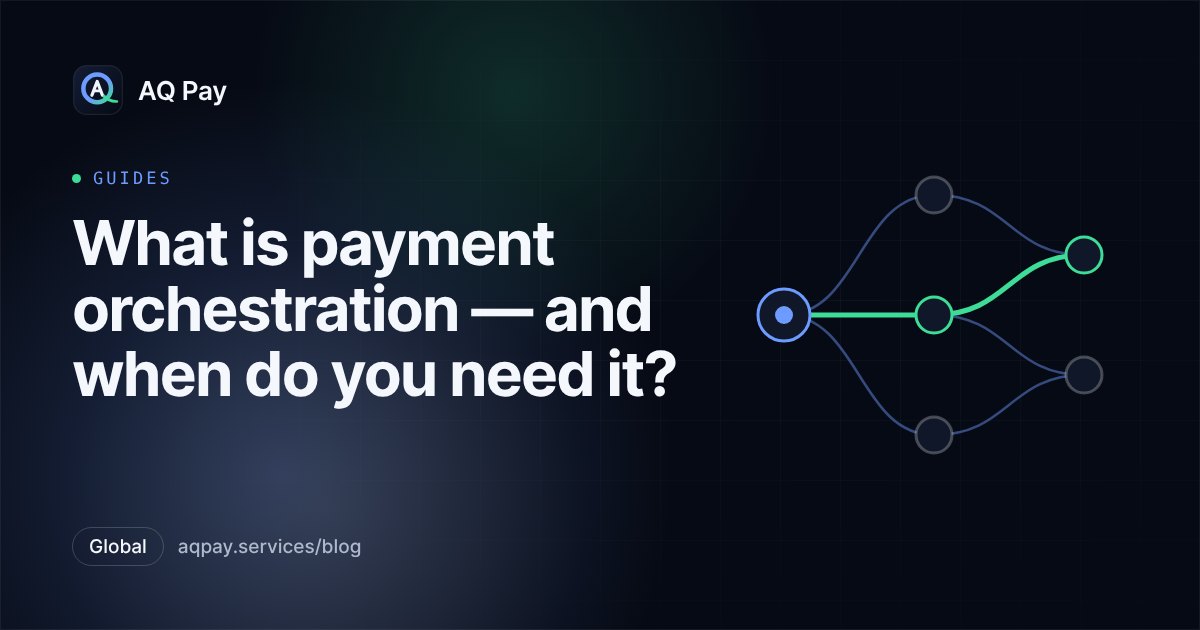
Payment orchestration is the layer that fixes that. Instead of wiring your checkout directly to a single PSP, you integrate once with an orchestration platform, and it decides — transaction by transaction — which provider, acquirer or payment method should handle each payment.
What payment orchestration actually does
At its simplest, a payment orchestration platform does four jobs:
- Connects to many providers — PSPs, acquirers, alternative payment methods — through maintained connectors, so your engineers don't build and maintain each integration.
- Routes each payment according to rules you control: card country, currency, amount, card brand, merchant, risk score or time of day.
- Recovers payments that fail for technical or soft-decline reasons by retrying them on another provider (cascading) or switching away from a provider that is down (failover).
- Normalises everything that comes back — statuses, decline codes, fees, settlement files — into one data model and one set of reports.
Why businesses outgrow a single provider
There is nothing wrong with one PSP until one of these becomes true:
- You sell across borders. Domestic acquiring usually approves domestic cards more reliably than cross-border processing, and some local payment methods are only available through regional providers.
- Downtime is expensive. If your provider has an incident, a single-provider setup means checkout stops. With orchestration, traffic can fail over automatically.
- You need negotiating leverage. With routing in your hands, you can shift volume between providers based on cost and performance — and your pricing conversations change.
- You are a platform or PSP. If you process on behalf of many merchants, you need per-merchant routing, onboarding and reporting that no single provider's dashboard gives you.
- Your data is fragmented. Two providers means two decline-code vocabularies, two settlement formats and two reconciliation processes. Orchestration normalises them.
The building blocks
Smart payment routing
Routing rules decide the first destination for each payment. Common rule inputs are card BIN and issuing country, currency, amount, card brand, merchant category and your own risk score. Good platforms let you combine conditions, split traffic by percentage for A/B tests, and change rules without a deployment. You can see how this works in practice on our payment orchestration page.
Cascading and retries
When a payment is declined for a reason that another provider might accept — a timeout, a generic "do not honour" on a provider-specific issue — the platform can retry it elsewhere. Retries need discipline: hard declines (stolen card, closed account) must never be retried, and issuers watch retry behaviour closely.
Failover
Failover is cascading at the provider level: if a provider's error rate spikes or its health check fails, new traffic is routed away until it recovers.
Tokenization and token portability
To route a returning customer's card to a different provider, you need to store the card in a way that isn't locked to one PSP. That means a vault you control (or that your orchestration provider controls on your behalf), plus support for network tokens where the schemes offer them. Ask any vendor how you would export your tokens if you left — and confirm how the vault is kept within the PCI DSS requirements.
Unified reporting and reconciliation
The least glamorous feature is often the most valuable: one place to see approvals, declines, fees and settlements across every provider, matched to your orders.
Orchestration vs. a gateway vs. a white-label platform
| Single gateway | Payment orchestration | White-label gateway platform | |
|---|---|---|---|
| Providers | One | Many | Many |
| Who uses it | A merchant | A merchant or platform | A PSP, ISO or platform running payments under its own brand |
| Routing control | Provider decides | You decide | You decide, per merchant |
| Branding | Provider's | Yours at checkout | Yours everywhere, including merchant dashboards |
If you want to run a payments business for other merchants — not just optimise your own payments — read our guide on white-label payment gateways vs. building your own stack.
When you don't need it yet
Orchestration adds a layer. If you sell in one country, through one provider, at modest volume, and that provider meets your needs, the extra layer may not pay for itself yet. A sensible test: do you have, or will you have within a year, at least two providers you'd like to route between? If not, revisit later.
How to evaluate a payment orchestration platform
- Connector coverage: are your current and likely future providers already supported, and who maintains the connectors when provider APIs change?
- Rule flexibility: can non-engineers change routing safely, and can you test rules before rolling them out?
- Token ownership: can you export your vault, and are network tokens supported?
- Decline intelligence: does it normalise decline codes so you can act on them?
- Risk tooling: pre-authorization screening, 3-D Secure orchestration and review queues.
- Operating model: does the vendor hold funds or stay out of the flow of funds? (AQ Pay deliberately does not hold client funds.)
The best orchestration setups are boring in production: rules are explicit, retries are disciplined, and every decline has a reason someone can read.
Getting started
Most teams start small: connect the PSP they already use plus one more, route one region or one card type differently, and measure. Once the data shows where the gains are, they expand the rules. If you'd like to see how that would look on your traffic, book a working session with our team or read the developer quick start.
Frequently asked questions
Is a payment orchestration platform the same as a payment gateway?
No. A payment gateway connects you to one processing path. An orchestration platform sits above several gateways, PSPs and acquirers and decides which one each payment should use, then normalises the results into one API and one set of reports.
Does payment orchestration increase approval rates?
It can, but only through specific mechanisms: routing to local acquirers, retrying soft declines on a second provider, and steering traffic away from a provider that is degrading. The size of the uplift depends on your traffic mix, so measure it on your own data rather than relying on generic benchmarks.
Do I need my own acquiring relationships to use orchestration?
You need at least one processing relationship for every provider you route to. Many businesses start by connecting the PSPs they already use and add acquirers as volume or regional needs grow.
Is orchestration only for large enterprises?
Not any more. Once a business uses two or more PSPs, or a platform needs to route on behalf of many merchants, the operational savings of a single integration and a single reporting layer usually justify it.
See it on your own use case
A 45-minute working session with the team that runs AQ Pay — no scripted pitch.